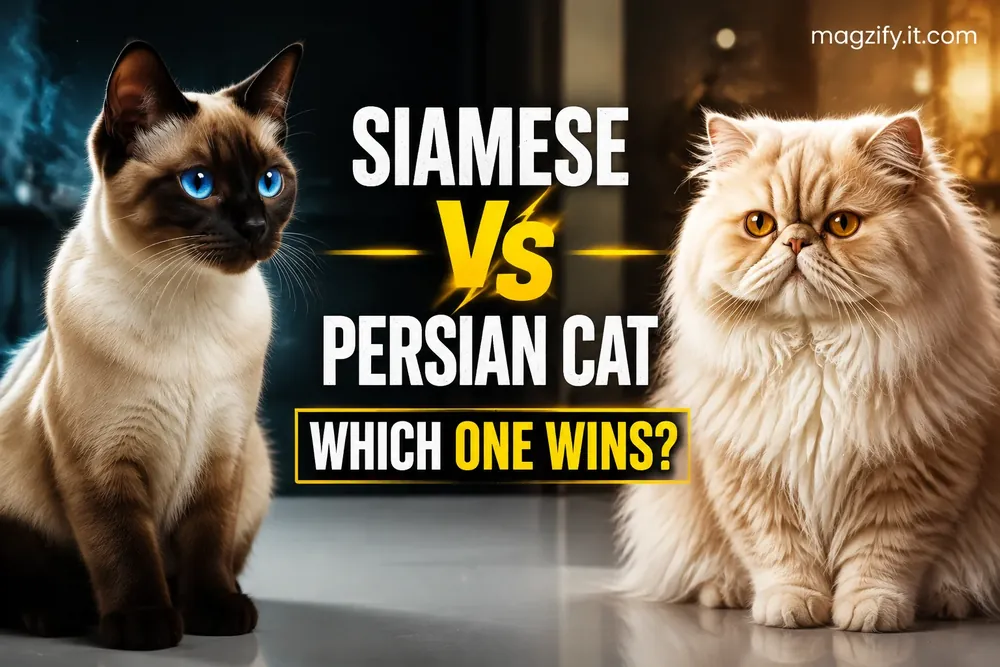
You are scrolling through cat photos when two faces stop you. One has a soft cloud of fur and round eyes. The other has bright blue eyes, pointed ears, and a look that says, "Pay attention to me."
Both are beautiful. But choosing by looks can lead to years of frustration. The real question is this: how much noise, grooming, and daily interaction can you honestly handle?
Persian and Siamese cats can both be loving pets. Yet they offer very different lives. A Persian is usually quiet and relaxed but needs serious coat care. A Siamese is active and easy to groom but may demand your attention loudly.
The honest verdict is: Choose a Persian if you want a calm, quiet companion and can commit to daily grooming. Choose a Siamese if you want a playful, talkative sidekick and have time for daily interaction. Neither breed is better for everyone. They are different lifestyles with fur on them.
Siamese vs Persian cat at a glance
Siamese and Persian cats differ most in energy, voice, and coat care. Use this table to match each breed to your home.
| Feature | Siamese | Persian |
|---|---|---|
| Personality | Social, curious, people-focused | Calm, gentle, low-key |
| Energy level | High, loves to climb and play | Low to moderate |
| Noise level | Frequent, loud voice | Usually quiet and soft |
| Affection style | Active, constant, attention-seeking | Quiet, steady companionship |
| Coat care | Weekly brushing | Daily combing and eye care |
| Shedding | Moderate, short hair | Heavy, long hair |
| Key health watch | Dental disease, HCM heart concern | PKD kidney risk, breathing, eyes |
| Home fit | Busy, social homes with time to play | Calm rooms with predictable routines |
Persian vs Siamese Cat Personality: Talkative Extrovert vs Quiet Homebody
The Siamese is the life of the party, while the Persian watches from the couch. This personality gap is the biggest difference between these famous breeds.
A typical Siamese cat wants to join everything. Cooking dinner? Your cat may inspect the counter. Taking a video call? Expect a loud opinion from beside your screen.
The Siamese cat personality is often described as social, curious, and people-focused. These cats can form strong bonds and may follow one favorite person throughout the home.
- Siamese energy level: High, with a strong drive to climb and play
- Siamese voice: Frequent, expressive, and sometimes very loud
- Siamese social style: Involved, persistent, and attention-seeking
- Siamese home preference: Busy homes with company and activity
Persians tend to move through life more slowly. They enjoy affection, but many do not need to supervise every household task.
- Persian energy level: Low to moderate
- Persian voice: Usually soft and used less often
- Persian social style: Gentle, steady, and less demanding
- Persian home preference: Calm rooms and predictable routines
Persians are often named among the calmest cat breeds. Still, breed traits are only a guide. Age, early social contact, health, and past experiences shape every cat.
Which Cat Is More Affectionate? It Depends on How You Define “Affection”
Siamese cats usually show affection more actively, while Persians offer quieter companionship. Both can love their people deeply.
A Siamese may trail you from room to room. It might call when a door closes, climb onto your lap, or tap your arm until play begins. For some people, that feels wonderfully close.
For others, it feels intense. That difference matters, especially if you work from home or need quiet time.
A Persian may sit beside you for hours without making a sound. Many enjoy gentle petting and warm resting spots. They are often content to share the room instead of controlling it.
- Choose a Siamese if you want constant, visible interaction.
- Choose a Persian if you want calm, low-pressure affection.
- Meet the individual cat before adopting whenever possible.
Are Siamese cats more affectionate than Persian cats? Not necessarily. They are usually more obvious about asking for affection.
Grooming and Shedding: The Persian Coat Is a Daily Job; the Siamese Is a Short-Coat Genie
If you want an easy-care coat, the Siamese wins clearly. Choosing a Persian means choosing a daily Persian cat grooming routine too.
A Persian’s coat is long and dense. Loose hair can tangle close to the skin. Mats commonly develop around the armpits, chest, belly, and back legs.
Once a mat becomes tight, brushing can hurt. Severe mats may need safe removal by a groomer or vet. Never cut close mats with scissors because thin cat skin is easy to injure.
A realistic Persian grooming routine
- Comb the coat daily, working gently from the skin outward.
- Check the armpits, belly, chest, tail, and back legs for tangles.
- Use a clean, damp pad to wipe discharge near the eyes.
- Watch for redness, odor, skin sores, or sudden hair loss.
- Ask a groomer or vet for help when mats cannot be loosened safely.
- Expect regular vacuuming and lint rolling around the home.
The Persian’s flat facial structure can also affect tear drainage. Some cats need frequent eye-area cleaning. Persistent discharge, squinting, or redness needs veterinary attention.
A Siamese has a close, short coat. Gentle weekly brushing often removes loose hair and keeps the skin easy to inspect.
Short hair does not mean zero maintenance. Siamese cats still need nail trims, dental care, parasite prevention, and routine vet visits.
Both breeds shed. No cat is truly hypoallergenic, regardless of coat length. Cat allergies are usually linked to proteins from saliva and skin secretions, not simply visible fur.
Noise Level & Attention: A Siamese Will Tell You Everything
If you need a quiet home, a Siamese is the riskier choice. This breed is famous for being one of the most talkative cat breeds.
A Siamese may meow when hungry, bored, lonely, excited, or locked out of a room. Some make low, drawn-out calls that carry through walls.
That can be charming during a conversation. At dawn in a small apartment? Maybe not.
Apartment dwellers should think beyond floor space. Is the building poorly insulated? Do neighbors hear normal conversations? A highly vocal cat may create stress even when it has enough room.
Persians are generally quieter. They may use a soft meow when they want food or attention, but constant calling is less typical.
What looks like “misbehavior” often reflects unmet needs. A bored Siamese may scratch furniture, knock items down, or call without stopping.
A healthy Siamese enrichment routine
- Schedule interactive play with wand toys.
- Offer puzzle feeders and rotate safe toys.
- Provide climbing shelves or a stable cat tree.
- Place scratchers near sleeping and social areas.
- Arrange companionship if the cat is regularly alone.
Boredom is not spite. If behavior changes suddenly, contact a vet. Pain, illness, or anxiety can look like a training problem.
Health and Lifespan: What to Ask Your Vet for Each Breed
Neither breed is automatically unhealthy, but each has a different medical watch list. Good breeding, preventive care, and early treatment matter more than labels.
Persians have a brachycephalic, or flat-faced, head shape. The degree varies. Cats with very flat faces may have noisy breathing, eye irritation, tear overflow, or trouble coping with heat.
Persian-line cats may also inherit polycystic kidney disease, called PKD. UC Davis Veterinary Genetics Laboratory identifies PKD1 as a hereditary condition seen in Persians and cats with Persian ancestry.
- Ask whether breeding cats received PKD genetic screening.
- Discuss breathing, eye drainage, and dental crowding.
- Report increased thirst, urine changes, or weight loss.
- Keep the cat cool during hot weather.
Siamese health discussions often include dental disease and heart concerns. Hypertrophic cardiomyopathy, or HCM, causes thickening of the heart muscle and can affect cats of many breeds.
- Ask your vet to listen for heart rhythm changes or murmurs.
- Discuss further heart testing if symptoms or family history raise concern.
- Start home dental care gradually with vet-approved products.
- Report fainting, weakness, or difficult breathing immediately.
Breathing trouble is always urgent. Open-mouth breathing, collapse, or blue-tinged gums require emergency veterinary care.
Do not choose a cat based on a promised lifespan. Genetics cannot guarantee an outcome. Routine exams, healthy weight, dental care, indoor safety, and fast treatment all affect longevity.
Do Persian Cats and Siamese Cats Get Along With Kids, Dogs, and Other Pets?
Both breeds can live happily with families, but Persians need gentleness and Siamese cats need engagement. Introductions and individual temperament matter.
A calm Persian may suit older children who understand boundaries. Rough handling, chasing, and tail pulling can frighten any cat. A Persian may hide rather than fight back, so adults must protect its quiet space.
A playful Siamese may enjoy older children who use toys safely. Its speed and intensity can overwhelm toddlers. An overstimulated cat may swat or nip, even without aggressive intent.
- Teach children to let the cat approach first.
- Keep faces away from the cat’s face.
- Do not disturb eating, grooming, or sleep.
- Use toys instead of hands during play.
- Supervise every young child-cat interaction.
Siamese cats often enjoy social homes and may bond with cat-friendly dogs. Persians can also live with dogs, but usually prefer calm animals that do not chase.
Introduce pets through scent and barriers first. Give each animal separate food, water, litter, beds, and escape routes. Do not force nose-to-nose meetings.
There is no useful answer to which breed would dominate a fight. Preventing conflict is the goal. Slow introductions are safer than testing which animal “wins.”
Persian vs Siamese Pros and Cons at a Glance
The Persian trades easygoing behavior for demanding coat care, while the Siamese trades an easy coat for demanding social needs.
Persian cat advantages
- Usually calm and quiet
- Often comfortable in peaceful apartments
- Enjoys gentle, low-key affection
- Lower play drive may suit relaxed households
Persian cat drawbacks
- Daily coat care is essential
- Mats can form and become painful
- Eye-area cleaning may be frequent
- Flat facial structure can create health concerns
- Heavy fur leaves visible hair around the home
Siamese cat advantages
- Highly interactive and people-focused
- Playful and eager to join family life
- Short coat is simple to maintain
- Often adapts well to active social homes
Siamese cat drawbacks
- Frequent vocalization can be stressful
- May struggle with long periods alone
- Needs daily play and mental challenges
- Bored cats may become disruptive
- Intense attention-seeking may interrupt work or sleep
It Depends: Which Cat Is Right for Your Home?
Choose with your calendar, noise tolerance, and grooming habits, not the cat’s face. Those three factors will shape daily life more than coat color.
Choose a Persian if:
- You prefer a quiet, low-energy home.
- You enjoy gentle companionship without constant demands.
- You will comb a long coat every day.
- You can clean the eye area when needed.
- You have calm children or pets.
Choose a Siamese if:
- You want an active cat that follows you around.
- You enjoy frequent meowing and interaction.
- You can provide daily play and mental stimulation.
- Someone is often home or companionship is available.
- You want a short, easy-care coat.
A busy pro who is away for long workdays should be cautious. A Siamese may become lonely. A Persian may cope better with quiet time, but it still needs affection, care, and daily grooming.
A first-time adopter may find an adult cat easier than a kitten. Adult personality is more visible. Rescue staff can often identify cats that are calm, social, independent, or comfortable with children.
“Choose Neither”: When the Third Option Is Smartest
If Persian grooming and Siamese noise both sound exhausting, choose a different cat. A mix does not guarantee an easier middle ground.
A Siamese Persian mix may inherit long fur, a strong voice, both traits, or neither. Appearance cannot reliably predict grooming needs or personality.
Consider an adult rescue cat with a known temperament. You may find a quiet short-haired cat, a social cat that tolerates workdays, or a gentle family cat without choosing by pedigree.
- Ask how the cat behaves when left alone.
- Ask about brushing, shedding, and litter habits.
- Confirm any history with children, cats, or dogs.
- Discuss known health and dental needs.
- Consider fostering before making a permanent commitment.
A Himalayan is related to Persian and Siamese ancestry, but registry classification can vary. TICA places the Himalayan in the Persian Breed Group. It has a Persian-type body and long coat with Siamese-style point coloration.
A Himalayan still needs substantial coat care. It is not an easy-grooming Persian alternative.
The Bottom Line: Match the Cat to Your Life
Choose a Persian for calm companionship, or a Siamese for active companionship. That simple difference should guide your decision.
The Persian fits quiet households that can handle daily coat care. The Siamese fits engaged households that welcome noise, play, and close involvement.
Be honest about what irritates you. Resenting meowing or brushing is unfair to both you and the cat. Choosing neither can be the most caring decision.
Both breeds can become wonderful companions when their real needs match your life. The best cat is not the prettiest photo. It is the one whose normal day feels comfortable in your home.
Frequently Asked Questions
Which is better, Siamese or Persian cat?
Neither is universally better. A Persian is often better for a quiet home with an owner committed to daily grooming. A Siamese is often better for an active home that welcomes loud communication and frequent interaction.
Are Persian cats the calmest breed?
Persians are often described as one of the calmest cat breeds. They tend to enjoy quiet rooms and gentle routines. Individual personality still varies, so meet the cat before deciding whenever possible.
Do Siamese cats meow a lot?
Yes, many Siamese cats meow frequently and loudly. They may call for food, play, company, or access to a room. Enrichment can reduce boredom-related calling, but it will not turn a naturally vocal cat into a silent one.
How can you tell if a cat is Persian?
Persians usually have long dense fur, round eyes, small ears, a broad head, and a short nose. Pedigree papers or reliable background records are needed to confirm breed identity. Looks alone cannot prove that a cat is purebred.
Are Siamese cats good apartment cats?
Siamese cats can live well in apartments if they have climbing space, play, and company. Noise is the main concern. Their strong voices may be difficult in buildings with thin walls or strict noise rules.
Is a Siamese Persian mix a Himalayan?
Not every Siamese Persian mix is a Himalayan. Himalayans were developed using Persian and Siamese ancestry, but a random cross does not automatically meet Himalayan breed standards. A mixed cat may have point coloring without being a pedigreed Himalayan.
Which cat breed is more misbehaved, Siamese or Persian?
Neither breed is naturally malicious. Siamese cats may appear more disruptive because they are active, vocal, and easily bored. Persians are usually quieter, but any cat may scratch, hide, or nip when stressed, frightened, or in pain.