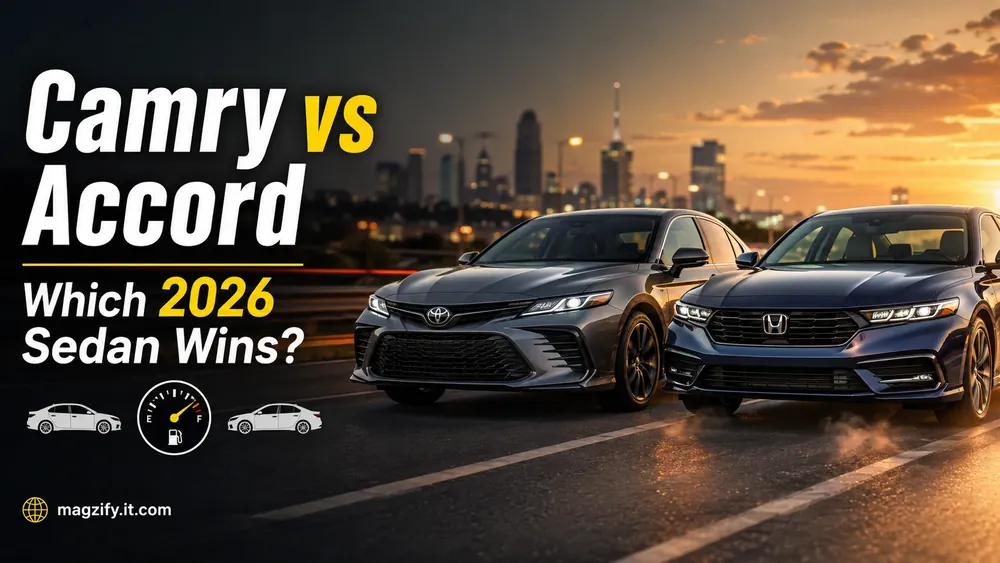
You are five years into owning your next sedan. Your back is tired after traffic, the fuel light is on, and an odd dashboard warning just appeared. What if the Camry vs Accord debate is asking the wrong question? The 2026 Toyota Camry is the better default midsize sedan for most shoppers because every trim is a hybrid; the 2026 Honda Accord is the better choice for drivers who prioritize sharper handling and a more polished interior.
No single car wins for every buyer. The right choice depends on fuel use, comfort, driving feel, reliability, and the price you actually pay.
That choice can feel stressful. Both cars have loyal fans, and much of the advice online mixes old models with new ones. If you are shopping used, pay close attention to the model-year section below.
The honest verdict is: Buy the Camry if you want standard hybrid power, a calm commute, and fewer decisions. Buy the Accord if you value sharper handling, a polished cabin, and a choice between gas and hybrid power. The Camry is the safer default for most new-car shoppers, while the Accord is the stronger driver’s car.
Toyota Camry vs Honda Accord at a glance
Camry and Accord differ most in powertrain, driving feel, and cabin character. Use this table to match the sedan to your driving life.
| Comparison factor | Toyota Camry (2026) | Honda Accord (2026) |
|---|---|---|
| Powertrain | Hybrid on every trim; no gas-only option | Turbocharged 1.5-liter gas engine or a hybrid system |
| Fuel economy | Efficient driving is the default; strongest in stop-and-go traffic | Hybrid rivals the Camry; the gas model is less efficient |
| Horsepower | Camry LE Hybrid (front-wheel drive): 225 hp | Accord Sport Hybrid: 204 hp |
| Driving feel | Smooth, calm, low-effort commuting | Sharper steering, more responsive and engaging |
| Interior | Simple, straightforward layout | More polished, upscale cabin feel |
| Reliability | Strong reputation; no proven longevity crown | Strong reputation; maintenance history matters most used |
| Safety | Toyota Safety Sense; verify current ratings | Honda Sensing; verify current ratings |
| Best for | Buyers who want standard hybrid power and fewer decisions | Drivers who value handling, cabin polish, and a gas option |
“2026 Camry vs 2026 Accord” Is Not the Same Debate as “Used Camry vs Used Accord”
The model year changes this comparison completely. The 2026 Toyota Camry has a hybrid-only lineup. The 2026 Honda Accord offers either a turbocharged 1.5-liter gas engine or a hybrid system.
Older Camrys are different. Some had regular gas engines, traditional automatic transmissions, or an optional V6. Older Accords also used different engines and transmissions.
That matters when someone says, “The Camry has a bigger engine and no CVT.” A CVT is a transmission designed to adjust smoothly instead of shifting through fixed gears. That claim may describe an older Camry, not the 2026 hybrid.
Use this buying order:
- Decide whether you need new or used.
- Pick a model year or generation.
- Compare gas and hybrid versions from that period.
- Choose the trim with the features you need.
- Request a written out-the-door quote.
- Estimate fuel, insurance, maintenance, and tire costs.
Skipping those steps can produce a misleading comparison. A used V6 Camry and a new Accord hybrid serve very different buyers.
Fuel Economy and Efficiency: The Camry Starts With Hybrid Standard; the Accord Can Match With Its Hybrid
The Camry makes efficient driving the default. Every 2026 Camry uses a hybrid system, which combines a gas engine with electric assistance.
The Accord requires another decision. Its 1.5-liter turbo is gas-only, while its hybrid is the direct rival to the Camry hybrid.
For a fair Camry hybrid vs Accord hybrid comparison, match similar trims. EPA estimates can change with trim, wheels, and drivetrain. Check the exact vehicles on fueleconomy.gov before signing.
Hybrids usually offer their biggest benefit in stop-and-go traffic. They can recover energy while slowing and use electric assistance at low speeds.
Do you spend two hours crawling through city traffic? The standard-hybrid Camry is especially easy to recommend. Highway drivers may see a smaller hybrid advantage because the gas engine runs more often at steady speeds.
- Heavy city commute: compare the two hybrids first.
- Mostly highway driving: calculate fuel cost using your real mileage.
- Lower upfront budget: price the gas Accord against available Camry discounts.
- Winter driving: confirm drivetrain availability on the exact trim.
Driving Feel and Performance: The Accord Feels Sharper; the Camry Feels Smoother
The Accord favors driver involvement, while the Camry favors calm progress. The Accord generally feels more responsive when steering, braking, and changing direction.
The Camry aims for an easier rhythm. Its smooth power delivery and relaxed character can reduce effort during a long commute.
Verified examples show the front-wheel-drive Camry LE Hybrid at 225 horsepower. The Accord Sport Hybrid is listed at 204 horsepower. Those numbers apply to those specific versions, not every Camry or Accord.
Horsepower also tells only part of the story. Seat position, steering response, tire choice, and road noise can shape the experience more than a small power difference.
Test both cars on the same roads. Include rough pavement, a highway entrance, tight parking, and a full stop. Ten minutes around a dealership may hide the traits that bother you later.
Reliability and Longevity: Toyota Has the Reputation, but This Is Not a Clean Knockout
Both sedans have strong reliability reputations, but neither has a proven longevity crown. No official automaker claim shows that every Camry lasts longer than every Accord.
Could either one reach high mileage? Yes, with proper care. But promises about 200,000 or 300,000 miles are not guarantees.
Long-term results depend heavily on:
- Model year and powertrain
- Oil changes and scheduled service
- Accident and flood history
- Climate and road salt exposure
- Driving habits and annual mileage
- Quality of past repairs
For a used car, maintenance records matter more than the badge alone. A documented Accord is usually a safer bet than a neglected Camry, and the reverse is also true.
Ask for an independent inspection. Check for fluid leaks, uneven tire wear, warning lights, and signs of repaired crash damage. Review reliability data for the exact year, not just the model name.
Hybrid battery health deserves attention on older cars. Battery life varies, so request a system check rather than assuming replacement is near or far away.
Interior Comfort, Space, and Ergonomics: The Accord Reads More Upscale; the Camry Reads Simpler
The Accord usually feels more polished, while the Camry keeps things straightforward. Some shoppers prefer the Accord’s cabin design and controls. Others find the Camry’s simpler layout less distracting.
Looks matter, but your body notices other details after an hour. A firm seat edge can press behind your knees. Poor lower-back support can leave you shifting at every red light.
During each test drive, check:
- Lower-back support after at least 20 minutes
- Seat cushion length and pressure points
- Steering-wheel reach without leaning forward
- Headroom with the seat in your normal position
- Road and wind noise at highway speed
- Ease of entry and exit
- Rear-door access for a child seat
- Climate controls you can use without hunting
Cabin air filters can help trap dust and pollen, but they need regular replacement. Neither car should be treated as protection from all outdoor pollution.
Which car is bigger? Do not judge space from the exterior alone. Compare official passenger and trunk measurements for the exact year. Then bring your stroller, luggage, or child seat to the test drive.
Safety and Driver-Assistance: Expect Both to Be Class Leaders, but Verify the Ratings
There is no responsible safety winner without current test results. Independent crash-test groups had not published verified 2026 ratings for these trims at the time of writing.
Check both organizations before buying. Ratings can vary by model year, build date, headlight type, and test category.
Toyota Safety Sense and Honda Sensing include driver-assistance features, but equipment can differ by year and trim. Confirm every feature on the window sticker.
- Automatic emergency braking
- Lane-departure alerts
- Lane-centering assistance
- Adaptive cruise control
- Blind-spot alerts
- Rear cross-traffic alerts
Driver aids are backups, not replacements for attention. They may react poorly to faded lines, severe weather, blocked sensors, or unusual traffic.
Parents should also test child-seat installation. Check lower-anchor access, rear-door opening, and front-seat space with a rear-facing seat installed.
Price, Value, and Total Cost of Ownership: Compare Out-the-Door Price, Not MSRP
The better value is the car with the stronger complete deal, not the lower advertised price. MSRP leaves out several costs that can change your decision.
Ask each dealer for an itemized quote showing:
- Vehicle selling price
- Destination charge
- Dealer documentation fees
- Taxes and registration
- Installed accessories
- Market adjustments
- Financing rate and loan term
Some Honda dealers add costly accessories. Toyota dealers can do the same. Decline products you did not request, and compare written quotes from several stores.
For a useful Camry vs Accord price comparison, also estimate five years of fuel, insurance, service, tires, financing, and depreciation. Get insurance quotes using the exact trim and vehicle identification number when possible.
Hybrid systems may lower fuel use and brake wear. They also add components that can be costly outside warranty. Review the official vehicle and hybrid battery warranties before buying.
A modest discount can outweigh a small efficiency difference. Run the numbers using your annual mileage, local fuel price, and actual loan rate.
Toyota Camry Pros and Cons
The Camry’s main strengths are standard hybrid efficiency and an easy ownership experience.
Pros
- Every 2026 trim uses hybrid power.
- Strong reputation for reliability and resale value.
- Smooth, calm character suits daily commuting.
- Simple powertrain choice reduces shopping confusion.
- Available efficiency without moving to a special hybrid model.
Cons
- No gas-only option in the 2026 lineup.
- May feel less engaging than the Accord.
- Some shoppers may prefer the Accord’s cabin finish.
- Hybrid-only power may not suit every used-car comparison.
Honda Accord Pros and Cons
The Accord’s main strengths are sharper handling, cabin polish, and powertrain choice.
Pros
- More engaging steering and road manners.
- Upper trims can feel refined and upscale.
- The hybrid is a strong Camry hybrid rival.
- A gas engine remains available.
- Better suited to drivers who value responsiveness.
Cons
- The gas model is not the direct efficiency rival to a Camry hybrid.
- Some buyers dislike the feel of a CVT.
- Dealer accessories can inflate the real price.
- No official evidence proves it lasts longer than the Camry.
Buy the Camry If:
Buy the Camry if low-stress hybrid commuting is your top goal. It removes the gas-versus-hybrid decision because every 2026 version is electrified.
- You drive often in stop-and-go traffic.
- You want smooth and predictable power.
- You value Toyota’s reliability reputation.
- You prefer a calmer ride over sharper handling.
- You want a simple cabin and ownership experience.
The Camry also makes sense for a first-time buyer who feels overwhelmed by powertrain choices. Focus instead on trim features, seat comfort, and the final price.
Buy the Accord If:
Buy the Accord if driving feel and cabin polish matter more. It rewards shoppers who notice steering response, balance, and interior details.
- You enjoy driving on curved or open roads.
- You prefer the Accord’s seating position and controls.
- You want a choice between gas and hybrid power.
- You are willing to compare more configurations.
- You find a stronger out-the-door deal.
The Accord hybrid is the fair match for the Camry. The gas Accord serves buyers who prefer a lower-priced non-hybrid option, depending on local pricing.
Choose Neither If:
Choose neither if a midsize sedan does not fit your real needs. A trusted name is not enough if the shape, price, or power source is wrong.
- Choose a Corolla or Civic-sized car if parking and price matter more than rear space.
- Consider an EV if you can charge reliably and want electric driving.
- Consider an SUV if you regularly carry strollers, pets, or tall cargo.
- Buy used if you drive very little and want to avoid new-car depreciation.
- Keep your current car if it is safe, reliable, and inexpensive to maintain.
Models such as the Tesla Model 3 or Hyundai Ioniq 6 may suit EV shoppers. Compare charging access, insurance, winter range, and repair support before switching.
The Bottom Line: Match the Sedan to Your Commute
The Toyota Camry is the overall default choice for most new-car buyers. Standard hybrid power, a smooth commute, and a strong reliability reputation make it easy to live with.
The Honda Accord is the better choice for an involved driver. Its sharper responses and polished cabin can make daily travel feel less routine.
There is no verified longevity winner. For used cars, model year, maintenance history, and inspection results should guide the choice.
Your final test is simple: drive both, price both, and calculate five-year costs. Choose the Camry for standard hybrid efficiency and calm. Choose the Accord for engagement and refinement.
Frequently Asked Questions
Is a Honda Accord better or a Toyota Camry?
It depends on your priorities. The 2026 Camry is the better default for standard hybrid efficiency and a calm commute. The Accord is better for sharper driving responses and a more polished cabin feel.
Do Camrys or Accords last longer?
No official automaker evidence proves that one always lasts longer. Both can reach high mileage with good care. Model year, maintenance records, climate, and repair history matter more than reputation alone.
Which is more reliable, the Toyota Camry or Honda Accord?
Both have strong reliability reputations. Check a current independent survey for the exact model year and powertrain. When buying used, prioritize service records and an independent inspection.
Which gets better fuel economy, the Camry hybrid or Accord hybrid?
Compare official EPA estimates for the exact trims on fueleconomy.gov. Wheels, equipment, and drivetrain can affect results. The Camry has one advantage: every 2026 trim is already a hybrid.
Which is bigger, a Camry or an Accord?
Compare official passenger volume, rear legroom, and trunk capacity for the exact model year. Exterior length alone does not show which cabin will fit your family better. Test your child seat or luggage in both.
Is the Toyota Camry available with AWD?
Check Toyota’s official specifications for the exact 2026 trim and local inventory. Drivetrain availability may vary by trim and market, so confirm it on the vehicle’s window sticker.
Which car has better resale value?
Both traditionally attract used-car demand, but reputation is not enough. Compare current independent depreciation forecasts for the exact trim. Purchase price, mileage, condition, color, and local demand all affect resale value.