You pull a tray of fries from the oven. They are hot, but pale and soft. The air fryer ads promise crunch in less time. Still, do you really need another box on your counter?
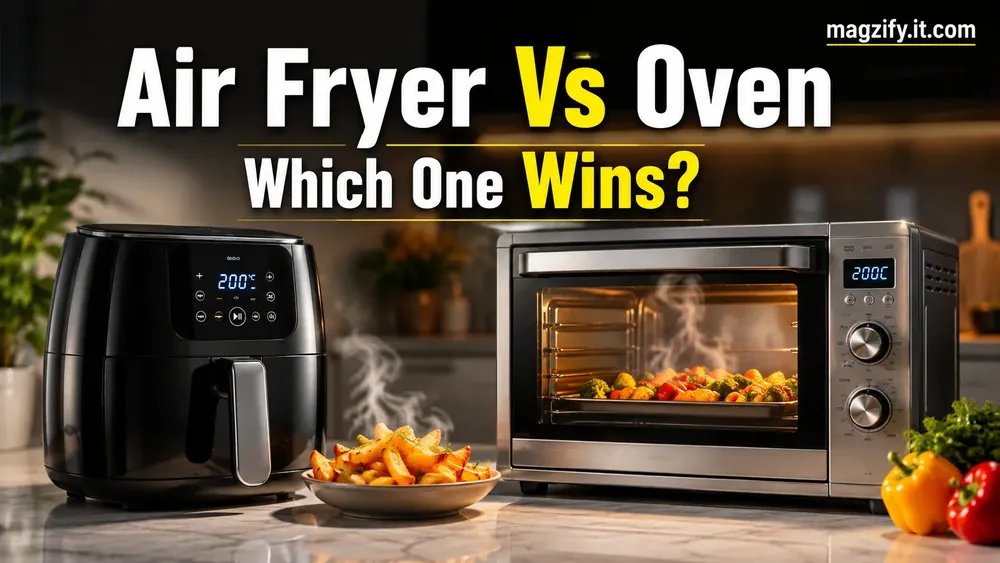
That question matters when money and space are tight. An air fryer is basically a small convection oven. It moves hot air around food fast. A conventional oven is larger and more flexible, but it often takes longer to heat.
Air fryers cook small portions faster and crispier, while ovens handle bigger and more varied meals. The best choice depends on how many people you feed and what you cook.
The honest verdict is: Air fryers win for speed and crispiness in small batches. Ovens win for capacity, baking, and large meals. An air fryer suits one to three people who want fast, low-oil food. If your oven already has convection mode, you can probably skip it.
Air fryer vs oven at a glance
An air fryer favors speed, while a conventional oven favors space. This table shows where each appliance fits.
| Comparison factor | Air fryer | Conventional oven | What decides the choice |
|---|---|---|---|
| Core technology | Heating element and strong fan in a compact cavity | Top and bottom radiant heat; some models add a fan | Whether the oven includes convection |
| Preheating | Small cavity warms rapidly | Large cavity takes more energy and time to warm | How soon food must be ready |
| Crispiness | Strong airflow dries and browns exposed surfaces | Radiant heat browns well when food is spaced apart | Fan setting, pan choice, and crowding |
| Oil use | Vegetables and proteins may need only a light coating | Roasted foods may also need only a light coating | The food and recipe |
| Capacity | Best for one layer and a few servings | Fits sheet pans, large dishes, and several racks | Household and portion size |
| Versatility | Air fries, roasts, reheats, and cooks small portions | Bakes, roasts, broils, braises, and cooks casseroles | Foods made most often |
| Energy use | Usually lower for one small dish | Can cook several dishes in one heated cavity | Wattage, run time, and number of batches |
| Cleanup | Basket and removable tray need washing | Sheet pan, rack, and spills need cleaning | Basket coating and dishwasher access |
| Kitchen space | Uses counter or cabinet space | Already built into a range or wall | Available work surface |
| Ownership cost | Requires a separate purchase and eventual replacement | No new cost when already installed and working | Budget and current appliance condition |
Air fryer vs oven: same technology, different package
An air fryer is a compact convection oven with intense airflow. Convection means a fan moves hot air around the cooking chamber.
The name “air fryer” is catchy marketing. The appliance does not fry food in a vat of oil. It surrounds the surface with dry heat instead.
A standard oven works differently. Heating elements warm a much larger space. Heat also radiates from the oven walls and elements.
Small size is the air fryer’s main advantage. Food sits close to the heat and fan. Moisture leaves the surface quickly, which helps create browned edges.
Is an air fryer healthier than an oven?
An air fryer is not automatically healthier than an oven. Both can cook vegetables, fish, and lean proteins with little added oil.
The clearer health advantage appears when air frying replaces deep frying. Deep-fried food absorbs oil. Air-fried food may need only a light spray or coating.
Cleveland Clinic notes that air frying can reduce added fat compared with frying in oil. Yet that does not make every air-fried food nutritious.
- Compared with deep frying: Air frying usually uses much less oil.
- Compared with oven roasting: The nutrition can be very similar.
- Compared with convection baking: The cooking methods are closely related.
- For processed foods: Air frying does not remove sodium, refined starch, or saturated fat.
A basket of frozen nuggets remains a processed meal. An oven-roasted plate of salmon and vegetables may offer more nutrients. The appliance does not decide the meal’s quality.
High heat also deserves context. The FDA says acrylamide can form in certain foods during frying, roasting, and baking. It is most relevant to starchy plant foods, such as potatoes and grains.
Both appliances can produce acrylamide when starchy food gets deeply browned. Aim for golden yellow potatoes rather than very dark brown ones. Avoid burning food.
The practical health test is simple: Which appliance helps you cook balanced meals at home? If an air fryer makes vegetables easier, that can support a useful habit.
Cooking speed: air fryer wins small batches, but not always
Air fryers usually cook small batches faster because they heat less space. Many recipes also need little or no preheating.
Fries, chicken pieces, and chopped vegetables often cook quickly. Hot air reaches each piece from several directions. Shaking the basket exposes new surfaces.
But there is a catch. Food needs room around it. A packed basket blocks airflow and traps steam.
The speed benefit fades when one meal requires several batches. Two crowded rounds may take longer than one large sheet pan in the oven.
- Use an air fryer for a few chicken thighs or one basket of vegetables.
- Use an oven for a full tray of chicken and vegetables.
- Leave space between pieces in either appliance.
- Check food early when adapting an oven recipe.
Cooking time also varies by model, food size, and starting temperature. Use the appliance instructions and a food thermometer when cooking meat.
Crispiness and texture: why air fryers can outcrisp ovens
Fast airflow helps an air fryer crisp exposed surfaces quickly. It carries away moisture before the food can steam.
Think about crowded potatoes on a tray. Their moisture collects between the pieces. They soften instead of turning crisp.
The air fryer basket allows air to pass around more of the food. Browning creates the toasted color and savory flavor people want.
A convection oven can come close when food is spread out. Use a metal sheet pan and leave gaps. A convection roast setting or brief broil can add color.
Still, an oven may be better for foods that need gentler heat. Cakes and breads need room to rise. Delicate toppings can blow around under a strong fan.
Energy use and cost: is an air fryer cheaper to run than an oven?
An air fryer generally uses less electricity for one small meal. It heats a smaller cavity and often runs for less time.
That does not mean it always costs less. Appliance wattage varies. Several air-fryer batches can erase the advantage.
Use this formula with the wattage on your appliance label:
Cost = watts ÷ 1,000 × hours used × electricity rate per kWh.
For example, enter your air fryer’s listed wattage and its full cooking time. Then repeat with the oven’s listed wattage, including preheating. Use the residential rate from your latest utility bill.
The US Energy Information Administration publishes national and state electricity prices each month. Your local bill is more accurate because rates vary by state and utility.
Portion size matters more than marketing claims. Heating a full oven for one potato wastes capacity. Cooking two sheet pans at once can make the oven efficient per serving.
Capacity and versatility: the oven still wins for big meals
A full-size oven remains the better tool for large and varied meals. It can hold wide pans, tall dishes, and several racks.
Holiday dinners make the difference obvious. A small basket cannot hold a turkey, casserole, and tray of vegetables. An oven can manage those foods in stages or together.
- Choose the oven for: Sheet-pan dinners, bread, cakes, cookies, pizza, and large roasts.
- Choose the air fryer for: Small portions, snacks, vegetables, fish, and crisp leftovers.
- Choose an air-fry toaster oven for: More capacity without using a full-size oven.
An air-fry toaster oven sits between the two. It may fit a small pizza or wider tray. However, it still takes counter space and needs cleaning.
Air fryer vs convection oven: is there a real difference?
The main differences are cavity size and airflow strength. Both appliances use a fan to circulate heated air.
A built-in convection oven spreads that air across a large cavity. An air fryer concentrates it around a small basket.
This concentration can make an air fryer feel more aggressive. Food may brown sooner and need turning or shaking.
A convection oven already provides much of the same benefit. An air fryer adds faster warmup and easier small portions, not a special health upgrade.
Pros and cons of air fryer vs oven
The air fryer offers convenience, while the oven offers range. The drawbacks become clear when you consider daily use.
Air fryer pros
- Fast heating and small-batch cooking
- Crisp texture with little added oil
- Useful capacity for one to three people
- Good results when reheating fries or fried chicken
- Lower energy use for many small dishes
Air fryer cons
- Small baskets can force multiple batches.
- The fan may be noisy.
- The appliance occupies counter or cabinet space.
- Nonstick baskets can scratch and wear.
- Grease may collect around the basket and heating area.
- Large baking dishes and roasts do not fit.
Oven pros
- Large capacity for families and guests
- Bakes, roasts, broils, and braises
- Fits common cookware and sheet pans
- Handles several foods at once
- Requires no extra purchase when already owned
Oven cons
- A large cavity takes longer to preheat.
- Small meals may use more energy.
- Hot spots can cause uneven cooking.
- It can warm the kitchen in summer.
- Spills may be awkward to clean.
It depends: the 3 questions that decide the right choice
Your household size, current oven, and favorite foods decide the answer. Ask these three questions before spending money.
1. How many people do you cook for?
For one or two people, an air fryer often fits the portion. For four or more, basket space becomes a problem.
Families usually get better batch capacity from an oven. A larger dual-basket air fryer may help, but it also takes more counter space.
2. Does your oven have convection mode?
If yes, try that setting first. Use a dark metal pan and leave space around food.
Without convection, an air fryer may produce a clearer jump in crispiness. It also avoids heating the whole oven for a snack.
3. What do you cook most often?
Fries, wings, roasted vegetables, and takeout leftovers suit an air fryer. Bread, casseroles, and sheet-pan meals suit an oven.
Limited on counter space? Consider neither. Use your existing oven, or replace a toaster oven with an air-fry toaster oven when needed.
Using what you own is often the healthiest financial choice. A new gadget saves nothing if it sits in a cabinet.
Can an air fryer replace a conventional oven?
No, an air fryer cannot fully replace a conventional oven. It can take over many small jobs, but not every cooking task.
It works well for small roasts, frozen snacks, fish, vegetables, and reheating. Some models can bake a few muffins or a small cake.
It cannot match an oven for multi-rack cookies, large casseroles, or family-size roasts. Its strong airflow may also disturb light toppings or batter.
The smartest workflow may be to use both. Bake the main dish in the oven while the air fryer crisps a side. Reheat the leftovers in the air fryer tomorrow.
This approach avoids forcing either appliance into the wrong job. It can also keep dinner moving when the oven is already full.
Final verdict: which should you buy?
Buy an air fryer for fast, crispy, small-batch meals. Skip it if you mainly bake, feed a crowd, or already get good results from convection mode.
- Busy parent: Keep the oven for family meals. Add an air fryer for one child’s snack or a fast side.
- Couple or empty-nester: An air fryer can reduce preheating and handle everyday portions.
- Health-conscious single: It may make vegetables and fish easier, but food choice still matters most.
- Frequent baker: Stay with the oven for space and steady heat.
Why do some people get rid of air fryers? The basket feels too small, cleanup gets annoying, or the appliance becomes clutter. Be honest about your habits before buying.
An air fryer is useful, not essential. It earns its space when you value speed and crisp texture more than large capacity.
Frequently Asked Questions
Which is better, an air fryer or an oven?
Neither is better for every cook. An air fryer offers speed and crispness for small portions. An oven offers capacity and more cooking methods. Choose based on household size and the meals you make.
Is an air fryer healthier than an oven?
Not automatically. Air frying can reduce oil compared with deep frying. Compared with low-oil oven roasting, the nutritional difference may be small. The ingredients and amount of oil matter more.
Why are people getting rid of air fryers?
Common reasons include limited capacity, fan noise, basket cleanup, worn nonstick coating, and lost counter space. Some owners also find that their convection oven already meets their needs.
What is the main disadvantage of an air fryer?
Small capacity is the biggest drawback. Food cooks best in one uncrowded layer. A family meal may require several rounds, which reduces the speed and energy benefits.
Does an air fryer use less electricity than an oven?
Usually, yes, when cooking one small meal. It heats less space and may run for less time. For several batches, a full oven may use energy more effectively per serving.
Can an air fryer replace an oven?
No. It can replace the oven for small snacks, vegetables, proteins, and reheating. It cannot match a full oven for large dishes, batch baking, or multi-rack cooking.
Does air-fried food have fewer calories than oven-roasted food?
Not necessarily. Calories depend on the food, coating, and oil. Both methods can use little oil. Both can also produce high-calorie meals when heavily breaded or processed foods are used.