It is 5:45 p.m. on Tuesday. You are tired, the chicken is still frozen, and the slow cooker recipe says it should have started this morning. Takeout is looking very tempting.
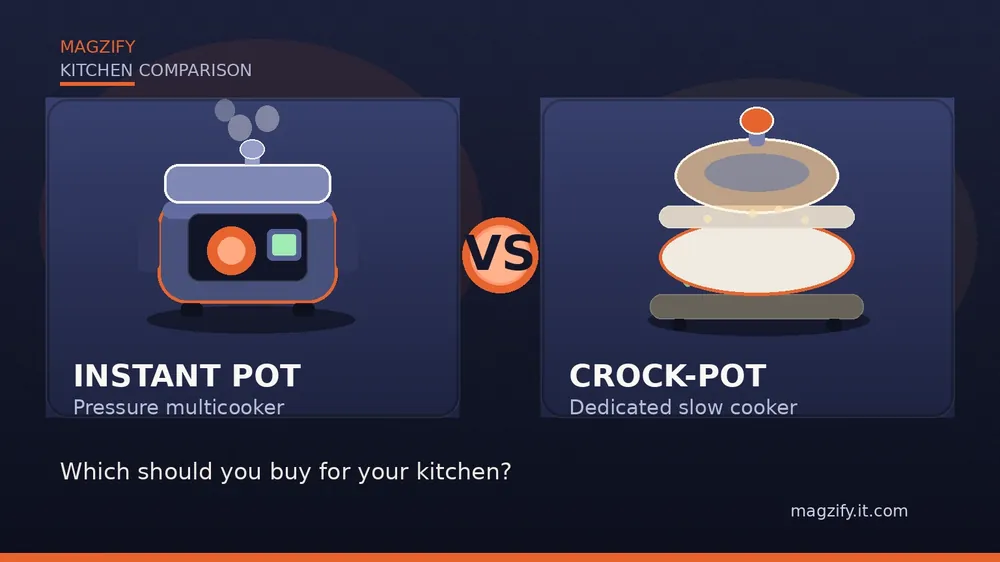
This is when the Instant Pot vs Crock Pot question matters. An Instant Pot helps when dinner needs to happen fast. A Crock-Pot works best when you planned ahead and want dinner waiting.
That choice can feel confusing, especially if you want healthier meals without another appliance gathering dust. The good news? Both can make home cooking easier. They simply solve different problems.
The honest verdict is: Buy an Instant Pot if you want fast beans, grains, soups, stock, and weeknight meals from one machine. Choose a Crock-Pot or dedicated slow cooker if you want simple, low-and-slow meals that cook while you are away. If your old slow cooker already fits your routine, an Instant Pot does not make it obsolete.
Instant Pot vs Crock Pot at a glance
The Instant Pot offers more speed and functions, while the Crock-Pot offers simpler slow cooking. Neither appliance is better for every household.
| Criterion | Instant Pot multicooker | Crock-Pot dedicated slow cooker | Best fit |
|---|---|---|---|
| Best use | Fast beans, grains, stock, soups, and weeknight meals | All-day stews, chili, roasts, dips, and baked potatoes | Your cooking schedule decides |
| Cooking method | Electric pressure cooking plus several other modes | Low, steady slow cooking | Your preferred food texture decides |
| Meal timing | Pressure cooking is fast, but heating and pressure release add time | Many recipes cook for 4 to 10 hours | Instant Pot for late starts |
| Controls | Several buttons, modes, and pressure settings | Simple low, high, and warm settings on many models | Crock-Pot for simplicity |
| Food results | Strong results with beans, stock, grains, and tough meat | Strong results with roasts, chili, dips, and slow braises | The recipe decides |
| Healthy cooking | Makes dry beans and whole grains easier to prepare | Makes home-cooked meals easy when ingredients are prepared early | The one used regularly |
| Capacity | Common product lines include 3, 6, and 8-quart options | Available in several round and oval sizes | Match capacity to household size |
| Cleanup | Inner pot, lid, valve, and sealing ring need care | Removable stoneware and lid need cleaning | Crock-Pot is usually simpler |
| Supervision | Pressure mode requires correct setup and careful steam release | Designed for long, unattended slow cooking when used as directed | Crock-Pot for all-day cooking |
| Price | Varies by model, size, and features | Varies by model, size, and controls | Compare current models directly |
Know the brand confusion first
Crock-Pot and Instant Pot are brands, not two names for the same appliance. Crock-Pot is best known for slow cookers. Instant Pot is best known for electric pressure multicookers.
People often use “crock pot” as a general name for any slow cooker. Crock-Pot also sells multicookers, including Crock-Pot Express products. Those compete more directly with Instant Pot models.
Here, Instant Pot means a multicooker with pressure cooking. Crock-Pot means a dedicated slow cooker.
That difference matters. An Instant Pot may include a slow-cook mode, but it does not always heat food like a dedicated slow cooker. The lid shape, heating pattern, and moisture control can change the result.
Speed: Instant Pot wins for weeknight cooking
If dinner must be ready tonight rather than tomorrow, the Instant Pot has the advantage. Pressure cooking traps steam inside a sealed pot. That raises the cooking temperature and speeds up cooking.
Dried beans, brown rice, stock, and tough cuts of meat can cook much faster under pressure. This is useful when you forgot to soak beans or start a stew before work.
Still, “cook time” is not the whole clock. You must also allow time for:
- The pot to reach pressure
- The programmed pressure-cooking cycle
- A natural or controlled pressure release
- Extra sautéing, thickening, or resting
There is no reliable universal conversion formula between slow-cooker hours and pressure-cooker minutes. Food size, liquid, density, and desired texture all matter.
Use a tested recipe for your model. Do not assume four hours on low equals one fixed pressure time.
Crock-Pot wins for true set-and-forget cooking
A dedicated Crock-Pot is the better fit for all-day, low-effort cooking. Add the ingredients in the morning, choose the correct setting, and let low heat do the work.
There is no pressurized lid to lock or steam to release. That feels calmer if buttons, valves, and hot vapor make you nervous. That concern is reasonable, especially when dinner already feels stressful.
America’s Test Kitchen has found dedicated slow cookers more reliable for slow-cooker recipes than the Instant Pot models it tested. A Crock-Pot is built around one main job, so its simplicity is a strength.
Slow cooking still requires food-safety care. Thaw meat when the recipe or manual requires it. Use enough liquid, follow tested recipes, and do not keep lifting the lid.
Cooking results: depends on the food
Pressure cooking suits some foods, while long, low heat suits others. Think about what you actually eat each week, not which appliance has more buttons.
Foods that suit an Instant Pot
- Dried beans and chickpeas without an all-day simmer
- Brown rice and other whole grains
- Chicken soup and meat-based stock
- Tough meat that needs fast, moist cooking
- One-pot curries, lentils, and stews
Serious Eats has reported that pressure cookers can produce richer stock than slow cookers. The sealed environment limits evaporation while higher heat extracts flavor efficiently.
Foods that suit a Crock-Pot
- Pot roast with a soft, falling-apart texture
- Chili that develops over several hours
- Baked potatoes and warm party dips
- Soups prepared early in the day
- Recipes designed around long, gentle cooking
Slow cookers can make vegetables mushy if everything goes in at once. They can also produce watery sauces because little moisture escapes. Adding delicate vegetables later often helps.
Cooking surfaces also differ by model. In one Consumer Reports comparison, the tested Crock-Pot Express had a nonstick surface. The tested Instant Pot had uncoated stainless steel.
Stainless steel can brown well but may stick. Nonstick surfaces can simplify cleanup but require gentler utensils and care.
Versatility: Instant Pot is the multicooker
The Instant Pot is more versatile because one machine can handle several cooking methods. Depending on the model, it may pressure cook, slow cook, steam, sauté, make rice, or ferment yogurt.
The sauté function is especially useful. You can soften onions, brown meat, add liquid, and finish cooking in the same inner pot. That means fewer pans in the sink.
A dedicated Crock-Pot is a specialist. It will not pressure-cook dry beans or quickly prepare brown rice after work. Yet fewer functions also mean fewer controls to learn.
More features only add value when you use them. If you make the same three slow-cooker recipes every week, a basic Crock-Pot may serve you better.
Health and nutrition: both are healthier than takeout, but not magic
Either appliance can support healthy meals, but ingredients matter more than the machine. Chicken and vegetables do not become nutritious because a digital display cooked them.
An Instant Pot makes beans and whole grains easier to cook from scratch. That may help you use fewer canned products and control added sodium. It also supports large-batch meal prep.
A Crock-Pot can keep home cooking realistic on busy days. You can load it with lean protein, vegetables, herbs, beans, and lower-sodium broth before leaving home.
Watch out for “dump-and-go” recipes built around:
- Canned cream soups
- Large amounts of cheese or cream cheese
- Processed sauces high in sodium
- Fatty meats with few vegetables
- Oversized portions
Pressure cooking may preserve some nutrients by shortening cooking time. Yet nutrient changes vary by food, heat, water, and cooking method. Do not choose an appliance based on a broad nutrient claim.
The healthiest choice is usually the tool that helps you cook balanced food several times a week.
Safety and supervision: what you need to know
Modern electric pressure cookers are designed with multiple safety controls, but they still demand attention. The sealed lid, pressure controls, and release system reduce the risks linked with older stovetop designs.
Pressure cooking can still feel scary. Maybe the steam hiss makes you step back. Maybe the locked lid feels unfamiliar. You can lower that stress by learning the controls before cooking dinner.
- Read the manual for your exact model
- Keep the steam valve and lid parts clean
- Never overfill the inner pot
- Use extra caution with foamy foods
- Keep hands and cabinets away from releasing steam
- Never force open a pressurized lid
Do not leave pressure mode running while you are away from home. Stay available to spot an error, loss of power, or blocked valve.
A slow cooker is designed for long cooking periods with less supervision. Follow the manual, place it on a dry heat-safe surface, and keep space around it.
Space, cleanup, and maintenance
A Crock-Pot is usually simpler to clean, while an Instant Pot has more working parts. Both still need washing after every use.
For an Instant Pot, clean the inner pot and lid. Check the sealing ring, steam valve, anti-block shield, and condensation collector as directed by the manual.
The silicone ring can absorb garlic, onion, and curry smells. Washing it promptly helps. Some owners keep separate rings for savory and mild foods.
A Crock-Pot usually has removable stoneware and a glass lid. These parts are straightforward, although the heavy insert can be awkward in a small sink.
Before buying, picture the appliance in your kitchen. Measure the shelf and overhead space. Remember that you also need somewhere to place the lid while serving.
Pros and cons
The trade-off is speed and range versus simplicity and dependable slow cooking. These lists show the practical differences.
Instant Pot pros
- Fast pressure cooking for late-start meals
- Several cooking functions in one appliance
- Useful for beans, rice, stock, and meal prep
- Sauté mode can reduce extra pans
- Stainless steel inner pots are available on many models
Instant Pot cons
- More controls and a steeper learning curve
- Bulky body and a large lid
- Steam release can be loud and intimidating
- Sealing ring and valve need regular cleaning
- Slow-cook mode may not match a dedicated slow cooker
Crock-Pot pros
- Reliable traditional slow cooking
- Simple, familiar controls
- Easy daily cleanup on many models
- Suited to unattended all-day cooking
- Works well with tested slow-cooker recipes
Crock-Pot cons
- Requires an early start
- Cannot pressure-cook food quickly
- Offers fewer cooking methods
- Vegetables may become too soft
- Sauces can stay thin or watery
It depends: use these three questions to choose
Your schedule, favorite foods, and tolerance for extra parts should decide. Ask yourself these three questions before spending money.
1. When do you have time to prepare dinner?
- Busy mornings and open evenings: Choose an Instant Pot for fast cooking after work.
- Open mornings and busy evenings: Choose a Crock-Pot so dinner cooks during the day.
- Unpredictable schedule: An Instant Pot gives you more late-start options.
2. What foods do you cook most?
- Beans, grains, stock, lentils, and quick stews: Instant Pot
- Pot roast, chili, dips, and all-day soups: Crock-Pot
- Crispy foods and roasted vegetables: Neither
3. How much kitchen stress can you tolerate?
- Choose a Crock-Pot if pressure and steam make cooking less appealing.
- Choose an Instant Pot if you enjoy learning settings and batch cooking.
- Keep your current appliance if it already supports your routine.
When should you choose neither?
Skip both if neither appliance matches how you eat. Crispy chicken skin and browned vegetables need dry heat. A sheet pan, oven, or air fryer is better for those jobs.
A Dutch oven may already cover stews and braises. A rice cooker may handle your grains. If you cook from scratch once a month, another countertop appliance may only create clutter.
Final verdict
For most people seeking speed and versatility, the Instant Pot is the stronger all-purpose buy. It shines when you need beans, grains, soup, or stew without planning all day.
Choose a Crock-Pot for reliable low-and-slow cooking with fewer steps. It is ideal when you can prep in the morning and want a familiar dinner routine.
Already own a slow cooker you love? Keep it. An Instant Pot adds pressure cooking, but it does not erase the value of a true slow cooker.
Recipe and workflow bonus: how to use both together
Using both can make sense when each appliance has a separate job. This is especially useful for family meal prep or large batches.
Pressure-cook dry beans in the Instant Pot. Meanwhile, build a chili base in the Crock-Pot with tomatoes, peppers, onions, and spices. Add the cooked beans later so they keep their texture.
You can also cook brown rice or another whole grain under pressure while a roast cooks slowly. That keeps the main dish and side dish on separate schedules.
Another option is to make stock in the Instant Pot, chill it safely, then use it in a Crock-Pot soup the next day. The goal is not owning more gadgets. It is making each tool earn its space.
Frequently Asked Questions
Is Crock-Pot the same as a slow cooker?
Crock-Pot is a brand of slow cooker. People often use “crock pot” as a general term, but other companies also make slow cookers. Crock-Pot also sells multicookers, so check the product type before comparing models.
Is Instant Pot better than Crock-Pot for healthy cooking?
Neither appliance is automatically healthier. Instant Pot makes beans and grains convenient. Crock-Pot makes planned home meals easy. Your ingredients, portions, and regular use matter more than the appliance name.
Can an Instant Pot replace my Crock-Pot?
It can replace a slow cooker for some recipes, but not every routine. Instant Pot slow-cook mode may heat differently from a dedicated Crock-Pot. Keep your Crock-Pot if you rely on tested all-day recipes.
What is four hours on slow cooker low in the Instant Pot?
There is no single safe time conversion. Pressure time changes with the food, cut size, liquid, and desired texture. Use a tested pressure-cooker version of the recipe rather than a simple multiplier.
Which appliance is better for a busy parent?
Instant Pot is better for fast evening meals, while Crock-Pot suits morning prep. Choose based on when you have ten minutes to load the appliance, not which one has more features.
Is an Instant Pot safe to cook in?
Modern electric pressure cookers include several safety mechanisms. Safe use still requires reading the manual, keeping valves clean, respecting fill limits, and staying nearby during pressure cooking and steam release.
Should I keep my old slow cooker if I buy an Instant Pot?
Keep it if you regularly make roasts, chili, large batches, or unattended all-day meals. If you rarely use it and the Instant Pot handles your recipes well, freeing the storage space may make more sense.