In this article
- Subwoofer vs speaker at a glance
- A subwoofer has one specialist job: deep bass
- No, a subwoofer cannot replace your main speakers
- For music, speakers provide balance while a subwoofer adds impact
- For movies and gaming, a subwoofer adds the missing thrill
- Budget changes the subwoofer vs speaker verdict
- Speakers are simpler, but subwoofer placement matters
- The case for each setup
It’s Friday night. The movie explosion should shake the couch. Instead, your setup sounds like a laptop playing through a sock. One friend says “subwoofer.” Another says “better speakers.” Both are half-right.
The subwoofer vs speaker choice comes down to your current sound. If everything sounds weak, regular speakers are the smarter first buy. If voices and music sound clear but lack thump, add a subwoofer.
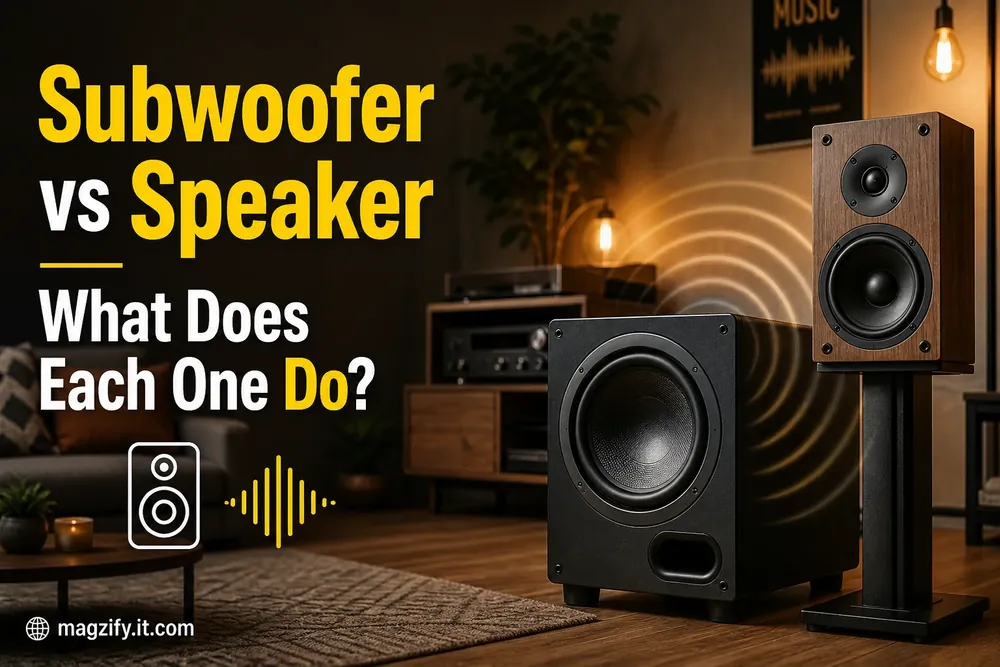
A subwoofer is a speaker built for deep bass. Regular speakers handle voices, instruments, and most other sounds. If you can buy only one, choose regular speakers. If you already like your speakers, add a subwoofer for deeper bass.
Subwoofer vs speaker at a glance
| Criteria | Regular speakers | Subwoofer alone | Speakers plus subwoofer |
|---|---|---|---|
| Main job | Play voices, music, effects, and everyday TV sound | Play bass and sub-bass | Split full sound and deep bass between dedicated units |
| Best use | Casual TV, podcasts, music, and smaller rooms | Adding low bass to an existing system | Movies, gaming, and bass-heavy music |
| Purchase type | Complete starting point | Add-on for compatible speakers or a receiver | Main speakers plus an extra bass unit |
| Setup | Connect and position the left and right speakers | Connect to a compatible output, then test placement | Connect each unit and balance bass with the main speakers |
| Sound on its own | Complete and balanced | Missing clear voices, melody, and high notes | Full sound with stronger low-end impact |
| Best choice for | First-time buyers | People who already own good speakers | People seeking the fullest home sound |
A subwoofer has one specialist job: deep bass
A subwoofer handles the lowest part of the sound. Regular speakers cover voices, guitars, piano, cymbals, and most effects.
Bass is more than a loud drum hit. It includes the low rumble under an explosion. It also gives dance tracks their weight. This is the sound you may feel through the couch or floor.
A regular speaker aims for balanced everyday sound. Some speakers produce solid bass on their own. Yet they may not reach the deep lows that make a room feel alive.
A subwoofer focuses on bass and sub-bass instead. That narrow focus lets it create the chest-thump many small speakers cannot deliver.
No, a subwoofer cannot replace your main speakers
A subwoofer cannot replace regular speakers because it plays only the low part of the audio.
Play a song through a subwoofer alone, and you may hear the kick drum. You may feel a low pulse. But the singer, guitar, and high notes will be missing or unclear. The result sounds incomplete and muffled.
That is why this comparison is not a true either-or choice. A regular speaker can work alone. A subwoofer usually cannot.
Think of the subwoofer as an addition, not a full system. It supports your main speakers rather than taking their place.
For music, speakers provide balance while a subwoofer adds impact
For most music, regular speakers win for balance. A subwoofer wins when you want to feel the beat.
Woofers inside regular speakers produce bass and mid-bass. That gives music punch and warmth. A separate subwoofer reaches deeper into the low sounds that create physical impact.
A subwoofer can be especially rewarding with:
- Hip-hop
- Electronic music
- Reggae
- Bass-heavy pop
- Movie soundtracks
Good regular speakers may be enough for:
- Acoustic music
- Jazz
- Vocal recordings
- Classical music
- Podcasts and radio
This does not mean jazz or acoustic music never uses deep bass. It means a subwoofer is less essential when clear vocals and natural instruments matter most.
For movies and gaming, a subwoofer adds the missing thrill
For movies and games, a subwoofer is one of the most noticeable sound upgrades. It adds weight to explosions, engines, thunder, and background rumbles.
Movie soundtracks often place important energy in the deep bass. You do not just hear that sound. You feel it. That physical effect makes action scenes seem larger.
Games benefit in the same way. A distant blast feels more convincing. A racing game gains the low growl that small speakers often miss.
Still, regular speakers remain essential. They carry dialogue, footsteps, music, and directional effects. The subwoofer adds impact beneath them.
Budget changes the subwoofer vs speaker verdict
Spend money on the weakest part of your current setup. Upgrade your speakers if everything sounds dull. Add a subwoofer if only the bass feels thin.
Better speakers improve more than bass. They can make dialogue clearer, instruments more natural, and effects easier to follow. That makes them the safer first purchase.
A subwoofer changes only the low end. That can be a huge change during movies or bass-heavy music. It will not fix harsh voices or muddy dialogue.
Consider powered bookshelf speakers if you want one simple purchase. They include their own power and can offer fuller sound than tiny TV speakers. Some also let you add a subwoofer later.
Speakers are simpler, but subwoofer placement matters
Regular speakers are usually easier to position and connect. A subwoofer needs more trial and error because bass changes around the room.
A sub can sound tight in one spot and boomy in another. Corners may make the bass feel too heavy. Furniture and walls can also change what reaches your seat.
Use this simple setup process:
- Check your receiver or powered speakers for a subwoofer output.
- Connect the subwoofer using the supported cable or wireless link.
- Start with the sub along a wall instead of hiding it in a corner.
- Play a familiar song or movie scene with steady bass.
- Listen from your normal seat.
- Move the sub slightly if the bass sounds weak or muddy.
- Adjust its level until it supports the speakers without taking over.
The goal is not maximum shaking. You want bass that blends into the sound, rather than one loud box announcing itself.
The case for each setup
Regular speakers
Pros
- Play the full sound range
- Work with music, TV, movies, and podcasts
- Offer the simplest starting point
- Fit many rooms and listening habits
- Can sound complete without extra equipment
Cons
- Small models may lack deep bass
- Action scenes may feel less powerful
- Strong low-end performance may require larger cabinets
Subwoofer alone
Pros
- Adds deep, physical bass
- Improves an existing speaker system
- Makes bass-heavy music more exciting
- Adds weight to movies and games
Cons
- Cannot play complete songs or dialogue
- Needs compatible equipment
- Can sound muddy when placed poorly
- May disturb people in nearby rooms
Speakers plus a subwoofer
Pros
- Delivers the best of both worlds
- Keeps voices clear while adding deep bass
- Makes movies feel more cinematic
- Gives music a fuller foundation
Cons
- Requires another purchase
- Takes up more floor space
- Needs extra setup and adjustment
- Can produce too much bass for shared walls
When should you skip a subwoofer?
Skip the subwoofer when deep bass creates more problems than pleasure. Apartments, small rooms, and shared homes can make bass hard to manage.
Low bass can travel through walls and floors. Your music may sound mild from the couch but loud in the next room. Apartment Alex may enjoy better speakers far more than an angry knock from downstairs.
A sub may also be unnecessary when:
- Your current speakers already sound full
- You mostly watch talk-heavy TV
- You listen mainly to vocals or acoustic music
- You need a simple, compact setup
- You care more about clarity than physical impact
Three alternatives may fit better:
- A soundbar with a wireless subwoofer for simpler TV setup
- Powered bookshelf speakers for balanced sound in one purchase
- Quality headphones for deep private listening
What should you buy?
If you have no sound system, start with regular speakers. They cover every part of the audio and work with almost any content.
If you already own speakers that sound clear, add a subwoofer. It can supply the weight your system is missing.
The best overall setup is speakers plus a subwoofer. The honest subwoofer vs speaker verdict, though, is simple: speakers come first, and the subwoofer completes them.
Frequently asked questions
Is a subwoofer better than a speaker?
No. They do different jobs. A subwoofer produces deep bass, while regular speakers handle voices, instruments, and most effects. Regular speakers are more useful on their own. A subwoofer becomes the better purchase when you already have clear speakers but want stronger low-end impact.
Can I use a subwoofer as my only speaker?
No. A subwoofer cannot reproduce a complete song, movie, or podcast by itself. You may hear low drums and rumbles, but voices and high notes will be missing. Use regular speakers for the main audio. Add a subwoofer beneath them for deeper bass.
Do subwoofers only play bass?
Yes. A subwoofer is designed for low-pitched bass and sub-bass. It handles rumbles, deep drum hits, and the low energy behind action scenes. This focus is its strength. It is also why a subwoofer needs regular speakers to produce clear, complete sound.
Do I really need a subwoofer?
You need one only if deep bass matters to you and your current speakers cannot provide it. A subwoofer is valuable for movies, gaming, hip-hop, and electronic music. It is less important for casual TV, podcasts, vocals, or listening in a home with thin walls.
What is the difference between a woofer and a subwoofer?
A woofer plays bass and mid-bass, which gives music warmth and punch. It is often built into a regular speaker. A subwoofer focuses on deeper low sounds and usually sits in its own cabinet. The woofer supports everyday sound, while the sub adds physical weight.
Can I add a subwoofer to speakers I already own?
Usually, if your equipment provides a compatible subwoofer output. Many receivers and some powered speakers include this connection. Check the ports and manual before buying. Passive speakers connected without a receiver may need extra equipment, so confirm how your current system sends power and audio.
What size subwoofer should I get?
Choose using the manufacturer’s room guidance, your available space, and your listening habits. A larger unit is not automatically the right choice. Placement and adjustment can matter as much as the cabinet itself. For shared walls or a small room, controlled bass is often better than maximum output.